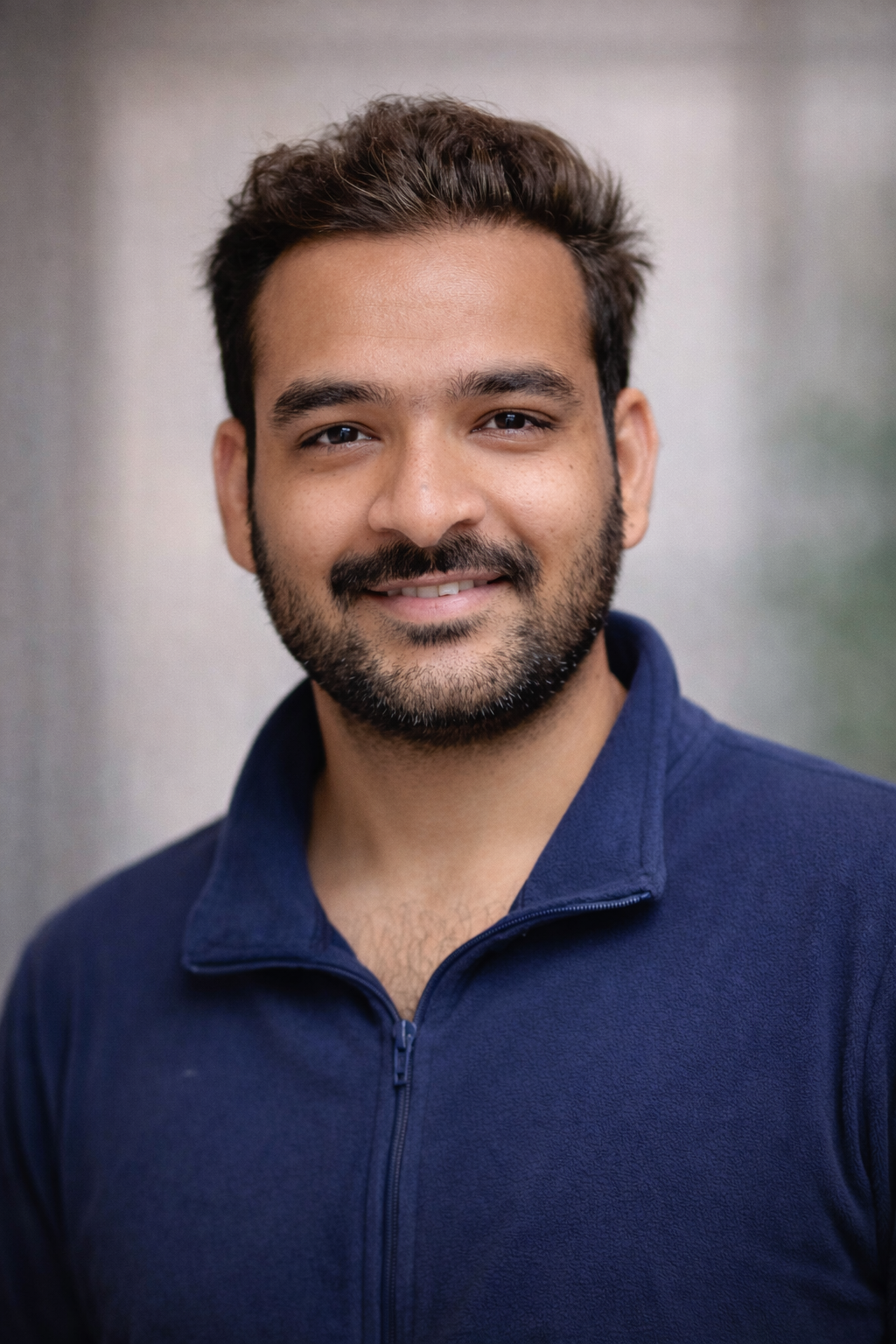
Devansh Pandey
I am a PhD student in Computational Biology and Bioinformatics at The University of Texas at Austin, advised by Dr. Vagheesh M. Narasimhan . My research focuses on developing multimodal AI frameworks that integrate imaging, genetics, and metabolic data to improve precision preventive cardiology and understand human evolution.
Previously, I completed my dual degree (B.Tech & M.Tech) in Biotechnology and Biochemical Engineering at the Indian Institute of Technology (IIT) Kharagpur.
- Multimodal AI
- Deep Learning
- Genomic Foundation Models
- Precision Preventive Cardiology
- Human Evolutionary Genomics
Research Interests
Genetic Architecture of Atherosclerosis
Investigating the genomic basis of atherosclerosis and its causal links to cardiovascular disease progression and clinical endpoints.
Precision Risk Stratification
Enhancing population-level risk prediction for Coronary Artery Disease (CAD) through the integration of large-scale imaging and genetic data.
Multimodal Phenotyping & Drug Discovery
Leveraging multimodal data to derive precise phenotypes for identifying novel, druggable genetic risk loci for cardiovascular diseases.
News
Research Experience
- Built a reproducible target-discovery pipeline across 402,200 UK Biobank participants (exomes to 360,410), integrating GWAS, LD-score genetic correlation, multivariable Mendelian randomization, colocalization, and SuSiE fine-mapping over seven lipid traits and CAD/MACE outcomes.
- Established LDL-C as the dominant causal lipid axis (multivariable MR OR 1.30 per SD, 95% CI 1.21–1.40 for CAD) and resolved 37 colocalized exposure×outcome loci (PP.H4 > 0.8), including PCSK9, LDLR, SORT1, APOE, and TRIB1.
- Converged common-variant signals with 341 exome-wide rare-variant burden associations to prioritize candidate effector genes and therapeutic targets.
- Trained a video masked-autoencoder on 69,932 UK Biobank cardiac cine-MRI studies and ran genome-wide association analysis on the learned representation; 18 of 20 latent axes were significantly heritable with well-calibrated statistics.
- Showed that heritability and standard GWAS diagnostics do not establish that a learned phenotype measures the intended anatomy — the leading axis tracked body-mass index (rg = −0.74, top locus FTO), and imaging centre was more decodable from the embedding than ejection fraction.
- Corrected this field-of-view confounding by restricting the view to the heart and residualizing the representation before dimensionality reduction, recovering reproducible cardiac-associated loci that add signal beyond 36 expert CMR measurements.
- Investigating the genetic architecture and heritability of rupture-prone plaque features using imaging and genomic data from 30,000 individuals in the SCAPIS cohort.
- Determining the genetic correlation between high-risk plaque features and major cardiovascular outcomes (CAD, stroke).
- Developed a novel multimodal deep learning framework to predict Coronary Artery Disease (CAD) risk, integrating imaging, genetics, and metabolic data from 65,000 UK Biobank participants.
- Demonstrated superior predictive accuracy (C-index 0.75) over established clinical tools, identifying a patient subgroup with a 15-fold elevated risk.
- Engineered a genomic foundation model by pre-training a GPT-2 architecture on the 1000 Genomes Project.
- Achieved a validation loss of 0.05 for next-variant prediction and improved performance over traditional HMM-based methods.
- Developed and applied a multi-locus genotype statistic (G12) on ancient DNA from 708 individuals spanning 7000 years.
- Identified 14 candidate regions of selection and showed how demographic processes obscured early adaptive signals.
Selected Publications
In Revision at Radiology: Artificial Intelligence.
npj Digital Medicine (2026).
Circulation, 152(Suppl-3):A4342257 (2025).
Science, 388, eadq1521 (2025).
Nature Communications, 15, 9772 (2024).
Service & Teaching
BioML Society | The University of Texas at Austin
Founding Member (Jan 2023 - Present)- Designed and conducted an eight-week seminar series on Bioinformatics and ML tools, attracting over 100 attendees.
- Developed seminar materials that were subsequently adopted as the curriculum for a new graduate course at UT Austin.
Principles of Computational Biology | UT Austin
Teaching Assistant (Aug 2024 -
Present)
Preparing and grading assignments and delivering tutorials on genomic data analysis using Python and R.